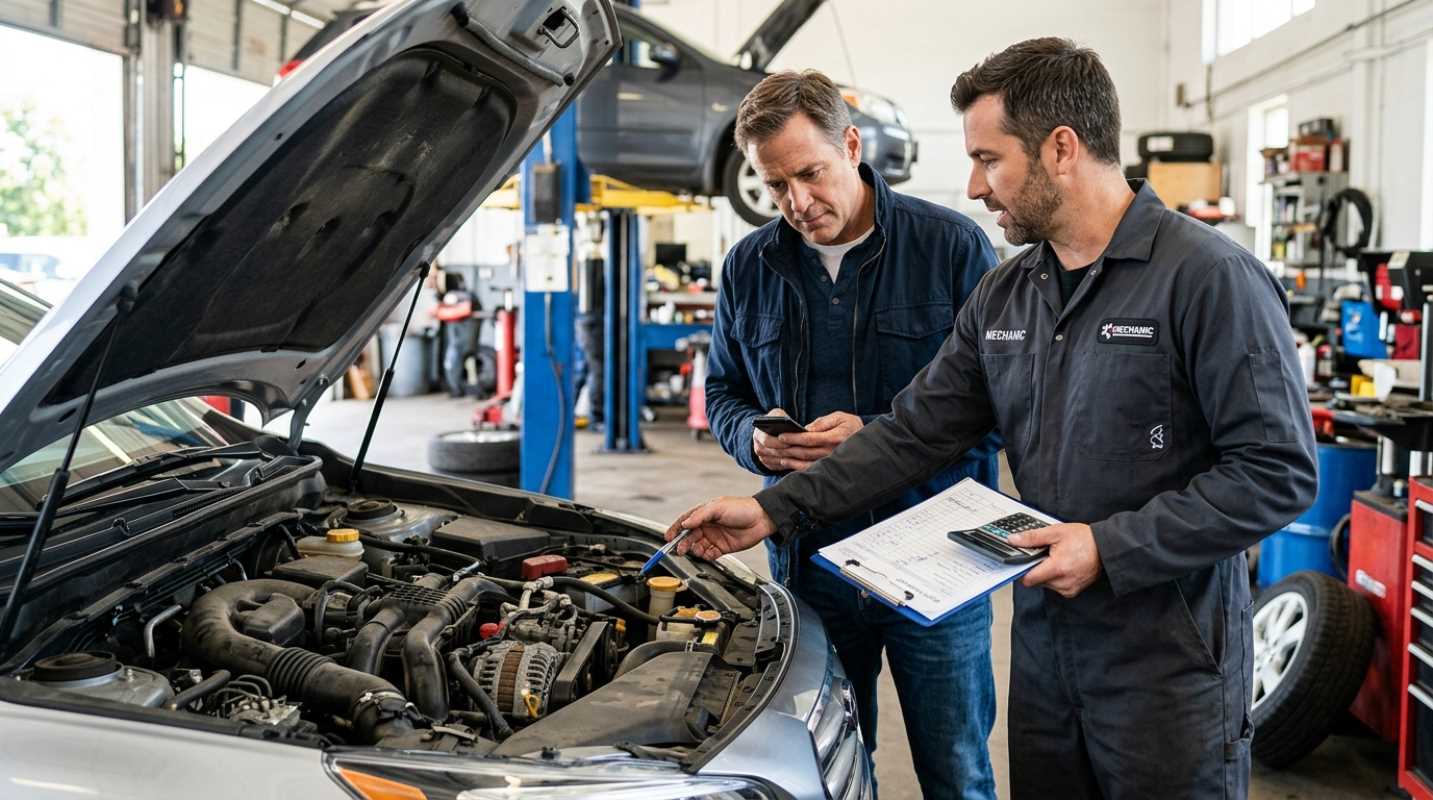
You are sitting in the service department waiting room. The coffee is lukewarm, the television on the wall is playing a morning talk show you aren't watching, and your mind is entirely focused on the mechanic. When they finally walk in with a clipboard and a look of pure sympathy, you know what's coming. Then comes the number: $3,500. Your stomach drops.
Have you been there? It is a moment almost every driver faces. Do you write the check and hope for the best, or do you finally trade the old ride in? The choice is never purely financial. It is a mix of logic, emotion, and daily survival.
Making the right call means looking past the immediate shock of a big bill. You need to focus on your vehicle's long-term value, comparing it to the actual costs of buying a replacement in today's wild market. Let's look at how to make that decision without losing your mind or your savings.
Assessing Recurring Expenses vs One-Off Fixes
Let's look at the math first. Is this repair a one-time hit, or is it the start of a constant cash drain?
There is a big difference between a single, major repair and a car that is slowly bleeding your bank account dry. A starter or an alternator is a wear-and-tear part. Once you fix it, you are usually good for years.
But when your car starts visiting the shop every other month, you are dealing with the "nickel and diming" effect. A $300 sensor here, a $400 suspension bushing there, and suddenly you are spending more on keeping the car on the road than you would on a monthly payment for a newer, more reliable vehicle.
If your car is over ten years old and begins showing this chronic behavior, the writing is on the wall. The parts are wearing out in a cascade. Fixing one thing just puts more stress on the next weakest link, leading to a never-ending cycle of repairs.
Safety Reliability and Modern Tech
Sometimes the decision is not just about dollars. It is about your peace of mind and physical safety.
If your mechanic points out structural rust, failing steering columns, or compromised airbag systems, the math changes. Driving a rolling hazard is never worth the savings. If a safety-important system cannot be repaired to original factory standards, it is time to move on.
You also have to think about what you are missing out on. Older cars lack the advanced safety features of newer models, like automatic emergency braking or blind-spot monitoring. They also burn more fuel, which adds up over thousands of miles.
Ask yourself honestly: Does this car still fit your life? If you have a longer commute now, or if you need a vehicle that won't leave you stranded on the highway late at night, a newer car is more than a luxury. It is a tool for your daily survival.
The Hidden Costs of Replacement
Before you run to the nearest dealership, stop and look at the real numbers. Buying a replacement car is incredibly expensive right now.
The average transaction price for a new vehicle recently hit a record $50,326.² If you finance that, you are looking at an average monthly payment of $767 for a new car, or $537 for a used one.
But the sticker price is just the beginning. You must look at the Total Cost of Ownership. A new car brings higher insurance premiums, registration fees, and sales tax. Plus, there is depreciation. A new car loses thousands of dollars in value the moment you drive it off the lot.
An older, paid-off car has already gone through its worst depreciation. Even if you spend $1,500 on a repair, that is far cheaper than taking on a new loan. Plus, you know your current car's history. Buying a used car means taking a gamble on someone else's ignored maintenance.
Three Rules of Thumb to Guide Your Choice
When you are staring at a massive repair estimate, you can use these simple mathematical frameworks to take the emotion out of the decision.
• The 50% Rule: If the cost of a single repair exceeds 50% of the car's current market value, you should replace the car.¹ Use online valuation guides to find your car's value in its pre-broken condition. If your car is worth $4,000 and the repair is $3,500, that is 87.5% of its value. Walk away.
• The 12-Month Payment Rule: Compare the repair cost to one year of monthly payments on a replacement. With the average used car payment at $537 a month, that is $6,444 a year.³ If a $2,000 repair keeps your paid-off car running for another year, you just saved over $4,400.
• The Mileage Threshold: If your car is under 150,000 miles, it is usually worth repairing. Once you cross that 150,000-mile mark, major components start failing in rapid succession. Expect a cascade effect of other parts failing shortly after.
Real World Examples
To see how this works in practice, let's look at two common scenarios.
• The Engine Dilemma: You drive a 2012 Ford Escape worth about $3,500. The transmission fails, and the mechanic quotes $4,200 for a rebuild.⁵ This violates the 50% rule. You should decline the repair, sell the car for scrap, and put that money toward a newer vehicle.
• The Wear and Tear Dilemma: You drive a 2015 Honda Civic worth about $9,000. It needs a timing belt, a water pump, and new front brakes for a total of $1,800.⁵ The repair is only 20% of the car's value. It is equivalent to less than three months of average new car payments. You should definitely repair it.
Navigating Your Final Choice with Confidence
Making this call does not have to be a guessing game. By using a clear framework, you can take the emotion out of the equation and make a smart financial decision.
Always get a second opinion before making a major decision. Car repairs have jumped roughly 9% recently, and dealership service centers often mark up parts by 40% to 60%.⁴ Taking your car to an independent mechanic can save you hundreds of dollars on the exact same job.
If the math says repair, do it with confidence and keep driving. If the math says replace, start shopping with a clear budget in mind.
To keep your car running smoothly and avoid these sudden financial shocks, you need the right tools and resources. Here are our top recommendations for keeping your vehicle in peak condition.
Sources:
1. Trusted Local Auto
https://trustedlocalauto.com/blog/repair-vs-replace-when-car-no-longer-worth-fixing
2. Kelley Blue Book
https://mediaroom.kbb.com/2025-10-13-Kelley-Blue-Book-Report-New-Vehicle-Average-Transaction-Price-Hits-Record-High-in-September,-Surges-Past-50,000-for-the-First-Time-Ever
3. Bankrate
https://www.bankrate.com/loans/auto-loans/average-monthly-car-payment/
4. Official Inflation Data
https://www.in2013dollars.com/Motor-vehicle-repair/price-inflation
5. CarX Auto Service
https://www.carx.com/blog/fixing-your-old-car-vs-buying-a-new-one/
*This article on AutomobileVehicle is for informational and educational purposes only. Readers are encouraged to consult qualified professionals and verify details with official sources before making decisions. This content does not constitute professional advice.*